

Home Generator and Transfer Switch Connection Video
|
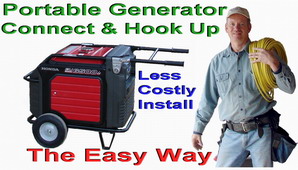
How can I connect a generator and transfer switch to my house to supply electricity? Basic Generator Connection to Power a Home, Generator Transfer Switch and Panel. © By: Dave Rongey |
Home Generator
Electrical Question: How can I connect a generator and transfer switch to my house to supply electricity?
- Upon buying my house which was rebuilt in 1987, I found a second fuse box in my garage with two 40 amp breakers and 2-15 amp breakers.
- Running out of the box is a 110 line powering my garage lights, a 110 outlet plug and a single what I believe to be a NEMA 6 – 30 amp plug.
- Is this an older version of a transfer switch?
- Can the NEMA 6-30 be converted to a 240 twist lock to connect to my generator?
- Will this get me the best usage from my generator? My generator is a Champion 7KW.
- The workmanship appears professional and the lines are run into my main panel via conduit under ground and is wired into a dual 50 amp breaker.
This home electrical repairs question came from: Gerry, from Nesconset, New York.
Dave’s Reply:
Thanks for your electrical wiring question Gerry.
Generator Power for a Home
Application: Installing a Home Generator.
Skill Level: Advanced – Best installed by a Certified Electrician or Licensed Electrical Contractor.
Tools Required: Electricians pouch of hand tools and the various power tools necessary for installing the generator, transfer switch, interlock kit, or generator circuit panel.
Estimated Time: Depends on the type and size of the generator and transfer switch or device and the available access to the project area.
Important: Installing a generator, transfer switch or generator panel must be well thought out and performed with a permit with all work being inspected.
Note: Back-feeding or using cheater cords to connect a generator to the home electrical system is extremely dangerous and should never be used.
Basic Generator Connection to Power a Home
- The electrical power connection of a generator to the home electrical system must be made safe to avoid damaging the generator or creating a hazardous condition for the home electrical system and the utility company.
- A generator should only be connected to the home electrical system by using an approved disconnect system that will prevent the back-flow of power into the utility company service wiring and to prevent the generator from being damaged when the electrical utility service is restored. This is typically provided by installing a transfer switch, circuit breaker interlock, or a dedicated generator panel with circuits that will be powered by the generator.
- All of these transfer switches or interlock systems or devices should be UL approved and installed with a permit and inspected, and is best performed by a licensed electrical contractor.
Generator Transfer Switch and Panel
- From what has been described in this question, Gerry has discovered a sub panel in the garage of this home, and this is not a transfer switch or the place to connect a generator unless you only wish to have the generator power up the circuits that are in this sub panel, however a circuit breaker interlock kit would need to be installed first if an interlock kit is available for this sub panel.
- The dual 50 amp breaker is most likely the disconnect or main breaker for the power source to the sub panel. A sub panel circuit should never be used to connect a generator for the purpose of back feeding the home electrical system. Refer to the explanation above.
More about Home Generators and Transfer Switches
- This series of articles covers a wide variety of topics all about home generators including sizing, selecting, connecting and safely operating this all important addition to your home.
- Generator Transfer Switch
The following may also be helpful for you:
|
|
Be Careful and Be Safe - Never Work on Energized Circuits!
Consult your Local Building Department about Permits and Inspections for all Electric Wiring Projects.
The Safest Way to Test Electrical Devices and Identify Electric Wires!The Non-Contact Electrical TesterThis is a testing tool that I have had in my personal electrical tool pouch for years, and is the first test tool I grab to help identify electrical wiring. It is a Non-contact tester that I use to easily Detect Voltage in Cables, Cords, Circuit Breakers, Lighting Fixtures, Switches, Outlets and Wires. Simply insert the end of the tester into an outlet, lamp socket, or hold the end of the tester against the wire you wish to test. Very handy and easy to use.
The Quickest Way to Check for Faulty Electrical Wiring!The Plug-In Outlet TesterThis is the first tool I grab to troubleshoot a problem with outlet circuit wiring. This popular tester is also used by most inspectors to test for power and check the polarity of circuit wiring. It detects probable improper wiring conditions in standard 110-125 VAC outlets Provides 6 probable wiring conditions that are quick and easy to read for ultimate efficiency Lights indicate if wiring is correct and indicator light chart is included Tests standard 3-wire outlets UL Listed Light indicates if wiring is incorrect Very handy and easy to use.
Strip Off Wire Insulation without Nicking and Damaging the Electric Wire!The Wire Stripper and Wire CutterMy absolute favorite wire stripping tool that I have had in my personal electrical tool pouch for years, and this is the tool I use to safely strip electrical wires. This handy tool has multiple uses: The wire gauges are shown on the side of the tool so you know which slot to use for stripping insulation. The end of the tool can be used to grip and bend wire which is handy for attaching wire onto the screw terminals of switches and outlets.. The wire stripper will work on both solid and stranded wire. This tool is Very Handy and Easy to Use. |
||


More articles about Generator, Transfer Switch and Home Electrical Wiring: |
|
| « Previous | Next » |
How to Repair a Vacuum Cleaner Cord |
Fix Light Switch Wiring |